
Press
Pope Francis joins prayer at St. Peter’s Basilica with Hakuna
Pope Francis took part in the Holy Hour organized by Hakuna at St. Peter's Basilica, sharing prayer and music with young members of the movement.
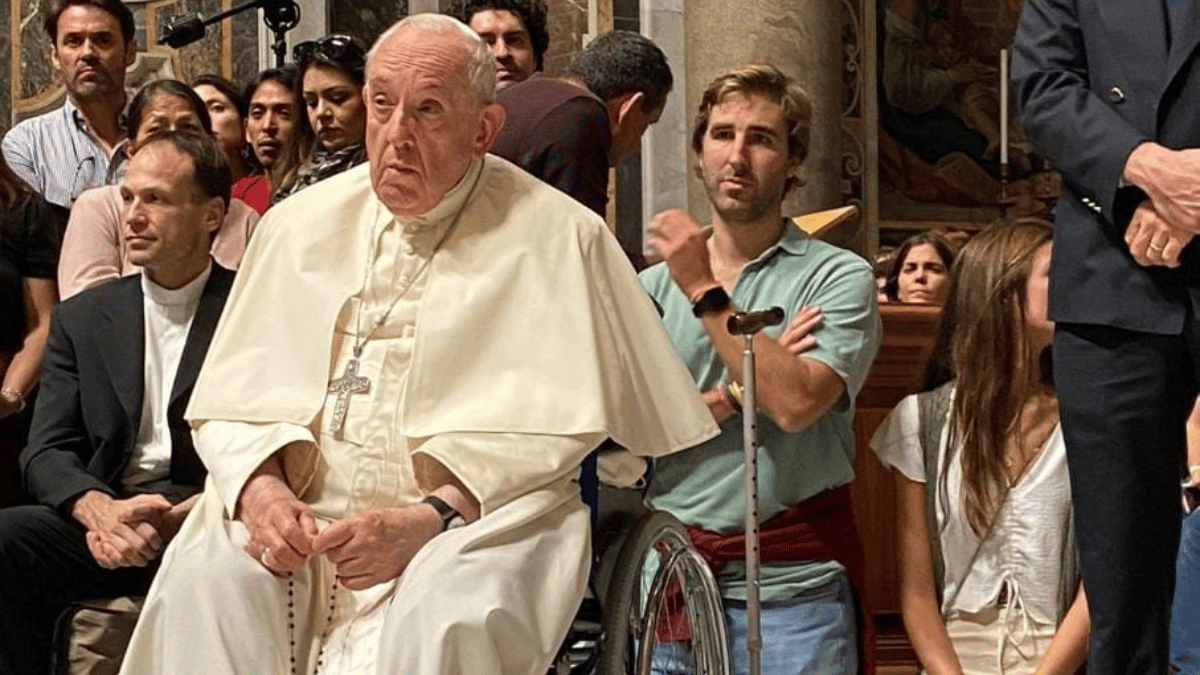
Pope Francis took part this weekend in the Holy Hour organized by Hakuna at St. Peter’s Basilica.
The Holy Father had been invited by this group of young Spaniards, led by priest José Pedro Manglano, former member of Opus Dei, to join this time of prayer at the Vatican.
Francis, rosary in hand, participated like anyone else, in a wheelchair, and positioned himself in a corner of the Basilica. Hakuna, this movement born in 2013 and approved by the Cardinal and Archbishop of Madrid, Carlos Osoro, as a private association of the faithful, organizes these times of prayer, or as they call it, “Holy Hour,” as the epicenter of their activities. During that time, the Blessed Sacrament is exposed, they pray and sing.
They did the same this Saturday at St. Peter’s, where they sang some of the most popular songs of this movement, ending with clapping and dancing accompanied by guitars.
The Spanish youth of HAKUNA (@be_hakuna) shared a time of prayer today with Pope Francis at St. Peter’s Basilica. pic.twitter.com/s4KP4nU7ed — Universitarios Católicos ♰ (@UniCatolicos_es) October 30, 2022
Hakuna was able to pray with the Pope. pic.twitter.com/kxI6nG6Fc8 — Jóvenes Católicos (@catolicos_es) October 30, 2022
Every year, around this time, Hakuna organizes in Rome the “Hakuna All Meeting.” In addition to Francis’ participation in the Holy Hour organized by this movement, the Holy Father also sent them a special greeting during the Angelus prayer to “the boys and girls of the Hakuna Movement.”
Last April, Francis sent a video to priest José Pedro Manglano, founder of Hakuna, encouraging him “to keep working and not to lose creativity.”
What is Hakuna?
“Christians who together follow Christ, sharing a lifestyle that we learn kneeling before Christ Host. And thus we learn to live kneeling before our neighbor, before life and before the world,” is how they define themselves on their website.
Their philosophy is based on “creating spaces of life in which we spread Life. We enjoy everything—even what the world despises—because everything is good, and thus we glorify God. We wish to collaborate with the Spirit to transfigure all realities. We strive to live with the joyful face of the resurrected. We want to make life a celebration, and make celebrations moments of life.”
Their charism is usually expressed through music: “we live what we sing and we sing what we live. Also with music we want to remind the world of the beauty of life, and show them the beauty of Christ.”
Hakuna today
Hakuna began in 2013 as a music group formed around Eucharistic adoration sessions convened by José Pedro Manglano at the parish of San Josemaría Escrivá de Aravaca when he was still a numerary priest of Opus Dei. Manglano was known for being the author of dozens of spirituality books. What started as a small music group ended up becoming an apostolic movement that brings together hundreds of young people.
Manglano left the Prelature in 2020 by mutual agreement with Opus Dei to dedicate himself expressly to the work of Hakuna. Due to the rapid growth experienced by this group, it became incompatible to combine his tasks within Opus Dei and lead this new movement.
Currently, this Association is made up of members they call “pringados,” who are generally young people committed to living a lifestyle according to Hakuna’s customs. The base of operations is a convent located in Las Rozas, known as “el Estudio,” where Manglano lives accompanied by members of Hakuna.
Hakuna has been established in numerous cities in Spain. Its presence is notable in cities such as Madrid, Barcelona, Valencia, Valladolid, Seville, or Murcia, where they enjoy good relations with their respective bishops. For now, José Pedro Manglano especially relies on diocesan priests who lend their parishes to Hakuna so they can hold their adorations. In addition, this Association already has several members in different seminaries, especially in the Conciliar Seminary of Madrid.
In 2019, in the preamble to the Statutes of the Hakuna Foundation, there was an explicit mention of the 2030 Agenda. “The Hakuna Revolution Foundation aims to help, as far as possible, the communities in which it operates and the stakeholders with whom it interacts to work towards these objectives,” could be read in reference to the global agenda. Now, that explicit mention of the 2030 Agenda has disappeared from the Statutes and from the Hakuna Foundation’s website.
