
Press
Hakuna Group Music: “We sing what we live and live what we sing”
Hakuna Group Music shares how their music is a testimony of faith and unity at the Resurrection celebration, conveying hope and authenticity to young people.
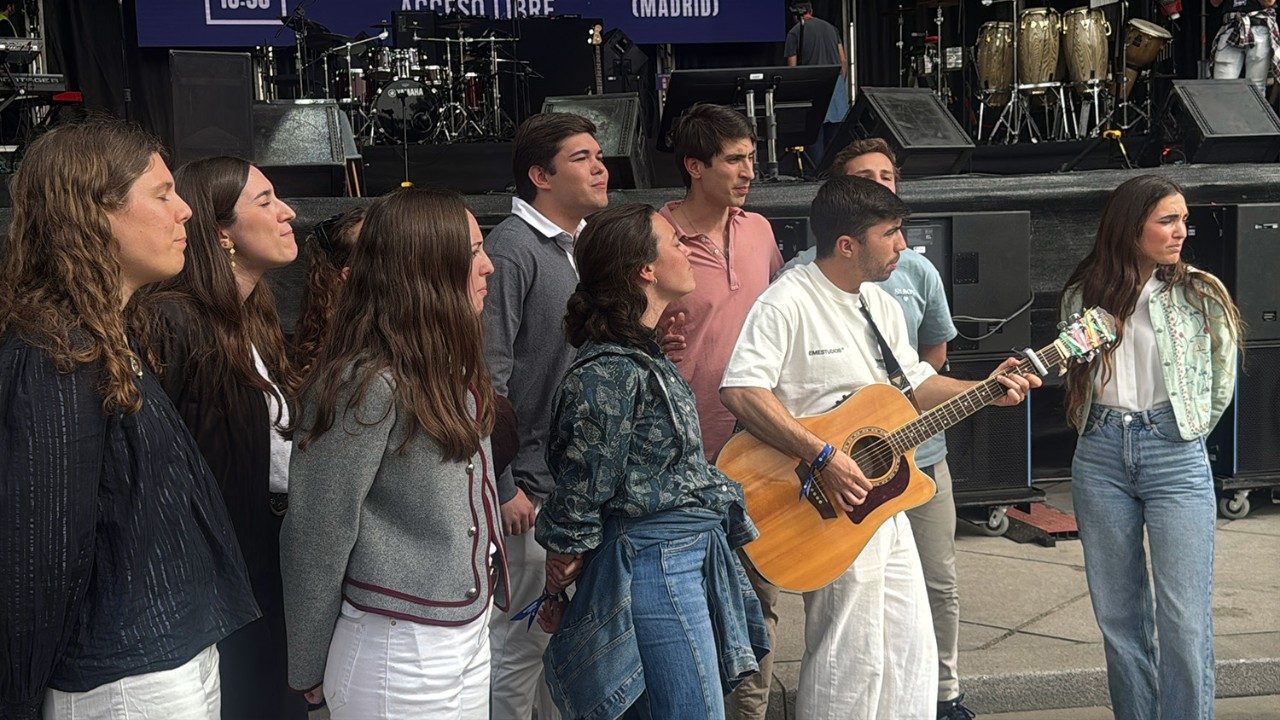
Hakuna Group Music once again gives voice to the celebration of the Resurrection in an event that, year after year, they consider an act of unity and gratitude towards the Church. For the group, their music does not arise from spectacle, but from a life of faith lived intensely: “Christ is alive” and that certainty, they say, is the message they wish to convey to young people with songs that are a testimony of what they believe and live.
Patricia Ynestroza – Madrid
Hakuna Group Music has become one of the most recognizable musical voices within the current Christian scene. Their presence at the event, the Resurrection celebration since it began four editions ago, far from becoming routine, continues to be for them a reason for gratitude, pride, and responsibility. In an interview with Vatican News, the group shared what it means for them to be part of this event consistently and why they believe the audience connects with something special in each edition.
Hakuna Group Music experiences their participation in this annual event as an act of ecclesial unity, gratitude, and mission. Their proposal is not based on spectacle, but on an inner experience that overflows into music. In a world where faith is sometimes hidden or caricatured, they opt for simple authenticity: truly living, singing what is lived, and celebrating that Christ is alive.
A gesture of unity and gratitude to the Church
For Hakuna, participating in this event is not just a musical opportunity, but a gesture of communion with the Church. They express it as an act of gratitude and also as a sign of mutual trust: they feel that the Church trusts them to convey an essential message.
That message is clear and direct: Christ is alive. For the group, the gathering becomes a collective proclamation of hope, a celebration of life and of the deep meaning of the Resurrection. They experience it as “a song to the life of God,” a way to shout to the world that the Christian faith is not an abstract idea, but a living experience.
In their words, participating is a reason for “much pride and much gratitude” for being able to be part of a Church that celebrates life with strength.
Being before doing: the key to their identity
In a social context where faith is often lived with timidity or even with some rejection, Hakuna insists on a central idea: what matters is not so much “doing things,” but truly being Christian.
During the interview, they emphasize that their style does not arise from an external strategy or a need to appear, but from an inner identity. For them, authentic Christian life must itself be a song of praise. And when that inner life is full of meaning, it inevitably translates into visible gestures: singing, dancing, celebrating.
Hakuna also recognizes an interesting social phenomenon: for years, living faith discreetly seemed enough, but in some environments it has gone to the opposite extreme, as if one had to constantly demonstrate faith with external symbols or forced attitudes. In the face of this, the group states emphatically that fully lived Christian life is the most explicit expression that exists.
A message for young people: life is incredible
When asked what message they want to convey to young people through their music, Hakuna does not respond with an elaborate slogan, but with a simple yet profound phrase:
“Life is incredible.”
For them, that life is not something to be conquered or possessed, but something to be received. The music is born from that inner experience: from prayer, from lived faith, from a life shared with Christ. They do not sing out of obligation or for show, but because they feel that what they have received is so great that they cannot keep it to themselves.
In this sense, they quote St. Augustine to explain that the life of God is something that cannot be retained or fully controlled: it can only be welcomed, lived, and expressed. And it is precisely there that the meaning of their music is born.
Music as testimony: living what is sung
The end of the interview leaves one of the most representative phrases of Hakuna Group Music:
“We sing what we live and live what we sing.”
This idea perfectly sums up their vision: music is not an addition to their faith, but a natural consequence. They do not seek to “represent” Christianity, but to express it from within. Music thus becomes testimony, celebration, and proclamation.
Hakuna does not intend to convince with complex speeches, but to share an experience: the joy of a life that, according to them, can only be fully understood when it is received as a gift.
